











You can train regularly and still stay in the same place. It is actually one of the most frustrating experiences in strength training, and it is more common than most people think.
The problem is rarely the effort. It is what the effort actually requires to work.
Muscle building is at its core about giving the body a reason to adapt. When you load your muscles enough, they will over time grow and become stronger, but only if the load is high enough and the body gets what it needs to complete the adaptation. It is the interaction between the two that determines whether you progress.
What does it take to build muscle mass?
To build muscle mass, your muscles must be exposed to a load they are not used to. This creates small micro-damages in the muscle fibers, which the body subsequently repairs and makes stronger.
But it is not enough to "train a little". If the load is not gradually increased, development typically stops quite quickly. The body is very good at adapting to the demands it meets. If the load is the same as last time, there is no reason to get stronger. That is why many can train steadily for a long time without moving forward noticeably.
The body does not react to how much you feel you train. It reacts to whether it has been challenged enough to have a reason to adapt.
How often should you train to build muscle?
Most people can build muscle mass by training somewhere between two and four times a week. That is enough to create progress if the training is actually challenging. In practice, for many this corresponds to 2-4 sets per exercise and 8-10 exercises per workout, depending on time and experience.
The decisive factor is not the exact number of days, but that there is a rhythm that can be maintained over time. Most people don’t fail because they train too little in individual weeks, but because they don’t do it consistently over months.
There is a tendency to overestimate how much is needed to get started. It is far more important to find a level that fits into everyday life than to go all-in for short periods. The best plan is the one you can actually stick to.
For many, it becomes easier when the training does not have to be invented each time, but follows a fixed structure. In JAAFIT træningsappen you will find programs where progression and variation are already considered from the start.
Which training works best for muscle growth?
Muscle building happens when the muscle is loaded enough that the body assesses it should adapt. It is not just about moving, but about working with a resistance that actually challenges the muscle.
That is also why repetitions and load are closely linked. If an exercise is so easy that you can do it without really feeling the muscle working, the stimulus is often too low. You won’t get bigger biceps from lifting a coffee cup twenty times a day, even though it is technically a movement. On the other hand, most people know the feeling of soreness in odd places after carrying moving boxes, scrubbing the patio or assembling a cabinet, because the load there was suddenly greater or more unusual than normal.
The most important thing is not whether you use weights, machines or bands. The decisive factor is whether the muscle is challenged enough for the body to have a reason to build more.
For most people, this means working with 6-15 repetitions per set and stopping while you still have 1-3 repetitions left in reserve. The exercises must be repeated over time, and the load must be adjusted continuously. It is that combination that drives muscle building, not variation for the sake of variation.
Strength training at home and muscle building
Strength training at home is for many the solution that actually works in everyday life.
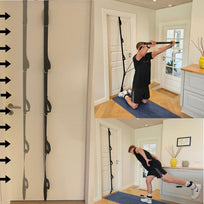
Muscle building depends on load, not where you train. If you can create enough resistance, you can build muscle at home. That is also why band training has become more widespread as a starting point for home strength training. They make it possible to adjust the load continuously and work the whole body without being dependent on machines or fixed equipment.
For many, the difference is not the quality of the training, but how often it is completed. A sufficiently good workout at home will always beat a perfect plan that is never followed. And when the training is accessible, it gets done more often.
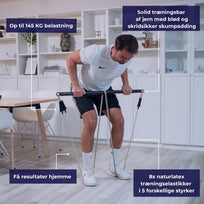
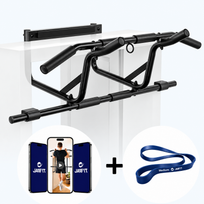
With a setup like JAAFIT PRO hjemmetræningssæt you can work with adjustable resistance and adapt the load as you get stronger. That makes progressive strength training at home possible, and that is exactly what drives muscle growth over time.
What slows down your muscle building?
It is rarely lack of will that holds you back. It is more often that the training becomes too imprecise to create progress.
The most typical reason is that the load never increases. You show up, do the same as last time and go home with the feeling of having done something good. But the body does not react to good intentions. It reacts to whether it has been challenged enough to have a reason to adapt.
Intensity is another area many underestimate. Many stop a set when it starts to bite a little, not when the muscle is actually pushed enough. As a rule of thumb, a set should feel so challenging that you could at most have taken 1-3 more repetitions. If you could do 5 or 10 more, the load is often too low.
A third classic is the chase for variation. New exercises can be motivating, but if you constantly change direction, it becomes difficult to see whether you are actually getting stronger. Muscle building does not require that you surprise the body all the time. It requires that you give it a reason to improve.
And then there is a factor that does not concern the training itself. If the body does not consistently get enough protein and energy throughout the day, building is slowed, regardless of how the training looks. The body simply has nothing to build with. You can read concretely about that in our article on how much protein you need for strength training and in our review of what your diet determines for your results.
How long does it take to increase muscle mass?
Muscle building happens gradually, and it can be difficult to see progress from week to week. In return, the difference becomes clear over time if you persist.
Most people will begin to notice strength improvements within the first weeks. Visible changes in muscle mass typically take longer, and for many it will take 8-12 weeks before changes begin to be clearly visible if the training is consistent.
The most important thing is to understand that progress is not linear. You don’t get stronger week to week, but you get stronger over time. Many stop too early because they expect faster results. It is patience and repetition that create the biggest changes.
Continuity builds muscle
If you want to build muscle mass, it is not about finding a shortcut, but about creating a structure you can continue with.
When load, progression and continuity align, results will come, whether you train at home or in a gym. It doesn’t have to be complicated to get started. A couple of weekly workouts where you work the whole body and gradually increase the load is often enough. You don’t need the perfect plan. You need a plan you can repeat.
If you want to read more about training and find concrete approaches, you can explore more articles in our blog universe.



Leave a comment
This site is protected by hCaptcha and the hCaptcha Privacy Policy and Terms of Service apply.